
How it works
Connecting a Borehole to Your House: Whole-Home Integration
By the WaterQuotes team · Published 2026-08-15 · 6 min read
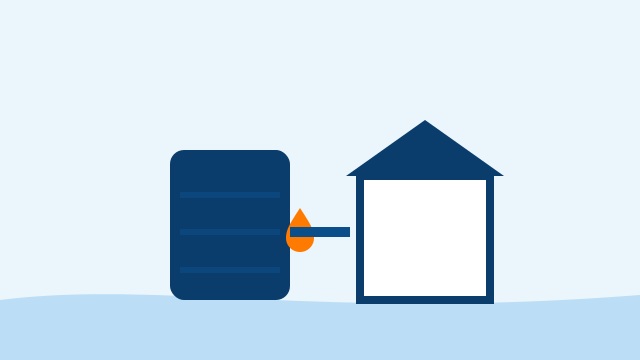
Plenty of Johannesburg homeowners drill a borehole and connect it straight to the garden irrigation — job done, water bill down. But a growing number want more: borehole water flowing to every tap, toilet, shower, and washing machine in the house. That is whole-home integration, and it is a meaningfully different undertaking. Here is what it actually involves, where the costs sit, and what to check before you commit.
How whole-home integration differs from irrigation-only
An irrigation-only borehole is relatively straightforward: a pump pushes water directly to a garden manifold at low pressure, the water never enters the house, and quality requirements are less stringent because nobody is drinking or bathing in it.
Whole-home integration means the borehole becomes a source for your domestic supply. That introduces several layers the irrigation setup never has to deal with:
- Water quality compliance. Water intended for household use must meet SANS 241 (2024 edition), South Africa’s drinking-water quality standard. That typically means filtration and, for potable use, disinfection — ultraviolet treatment or chlorination being the most common approaches.
- Pressure matching. Your house plumbing expects a consistent pressure range. Borehole pumps often deliver at pressures that differ from municipal norms, so a pressure-regulating valve or a pressure vessel (accumulator) is usually part of the system.
- Storage capacity. Because borehole yield is finite and fluctuates, whole-home systems almost always include a holding tank to buffer supply. Sizing that tank correctly is not trivial — see the detailed guidance on borehole storage tank sizing for the calculation logic.
- Switchover mechanism. You generally want the option to fall back on municipal water when the borehole cannot keep up — during a period of low yield, or while the pump is being serviced. A transfer switch (manual or automatic) handles this.
The main components you will need
A whole-home borehole system is essentially several sub-systems bolted together. A typical Johannesburg installation includes:
| Component | What it does |
|---|---|
| Submersible borehole pump | Lifts water from the aquifer to surface |
| Riser pipe and electrical cable | Connects the pump to surface |
| Holding / storage tank | Buffers supply and protects the pump from dry-running |
| Transfer pump (pressure pump) | Pressurises water from the tank into the house |
| Pressure vessel / accumulator | Smooths pressure fluctuations, reduces pump cycling |
| Filtration and treatment train | Removes sediment, iron, and pathogens to SANS 241 levels |
| Transfer switch or changeover valve | Switches between borehole and municipal supply |
| Float valve and level controller | Automates tank filling and protects the borehole pump |
Not every installation needs every item on that list — a property with a very high-yielding borehole and good native water quality needs less infrastructure than one drawing from a shallow, iron-rich aquifer. Get a water quality test done before specifying treatment equipment; it is money well spent.
What to expect on cost
Costs stack up across several separate contracts. As a rough guide:
- Complete borehole system (drilling, casing, pump, initial piping): R40,000–R150,000, with most Johannesburg installations landing between R60,000 and R100,000. The wide range reflects drilling depth, geology, and pump specification — you cannot know the final number until the borehole is drilled and the yield is measured.
- Borehole pump alone, installed: typically R15,000–R35,000.
- Backup tank-and-pump system for whole-home integration: typically R20,000–R40,000; whole-house examples with appropriate tank sizing and transfer plumbing tend to come in around R55,000.
- Filtration and treatment: costs vary considerably depending on what the water test reveals. Confirm via quotes once you have your test results.
- Municipal changeover plumbing: a relatively small add-on, but it must be done by a registered plumber to comply with local bylaws.
These figures are starting points, not quotes. Geology, depth to water, distance from borehole to the house, and existing plumbing infrastructure all shift the number. The only reliable way to budget is to get itemised quotes from vetted installers who have seen your site.
If you are still at the planning stage, comparing installer prices before you drill can save you a material amount. Compare 3 free quotes — vetted installers, no obligation.
Plumbing and regulatory requirements
Connecting borehole water to your household plumbing is not a DIY job in Johannesburg — and that is not just caution, it is regulation. Johannesburg Water’s bylaws prohibit cross-connections between borehole supply and the municipal reticulation without appropriate backflow prevention. A registered plumber must sign off the connection.
The practical requirement is that your municipal supply and borehole supply remain physically separated at the point of entry into the house, or that a testable backflow preventer is installed. The transfer switch arrangement — where the house is served by either one source or the other, never both simultaneously — is the cleanest way to satisfy this.
For potable use (drinking, cooking, bathing), the Department of Water and Sanitation recommends that private water sources meet SANS 241. While there is no routine municipal enforcement of in-home borehole water quality, the liability for any health consequence sits with the property owner.
Realistic yield expectations and what happens when demand spikes
Boreholes in the Johannesburg area sit in the Witwatersrand Supergroup geology — a hard-rock aquifer system that can be productive but is not uniformly so. Yields range considerably, and a borehole that easily keeps up with irrigation may struggle to supply full domestic demand for a large household.
A whole-home system buffers this through the storage tank. The full guide on borehole storage tanks and sizing walks through how to match tank volume to daily household demand and borehole recovery rate. As a principle: the lower the yield, the larger the tank needs to be.
You should also plan for the borehole pump being offline periodically — servicing, power outages, or temporary yield drops during dry periods. This is precisely why the municipal switchover is worth the extra plumbing cost. Context matters here: Johannesburg Water’s own figures show non-revenue water at 44.8% (2024/25 audited), which reflects the stress on the reticulation network. Having a borehole with proper changeover infrastructure means you are genuinely less dependent on the grid, not just partially so.
Once you know your borehole yield and water quality results, getting competitive quotes on the integration plumbing is the logical next step. Get installer quotes for your whole-home setup — no obligation, no pressure.
Is whole-home integration worth it for your property?
For most Johannesburg homeowners, the honest answer is: it depends on yield, water quality, and how much you value genuine independence from municipal supply.
If your borehole delivers a consistently strong yield and the water test comes back clean (or treatable at reasonable cost), whole-home integration is a sensible investment — particularly given the city’s 27-hour storage buffer in the reservoir system, which leaves little slack when supply disruptions occur.
If your yield is marginal, it may make more sense to limit borehole use to irrigation and non-potable functions like toilet flushing, and reserve municipal water for drinking and bathing. That hybrid approach costs less to set up and carries less treatment obligation.
Either way, the starting point is a proper borehole assessment — drilling depth, yield test, and water analysis. The borehole drilling overview covers what to expect from that process and how to evaluate a driller’s quote. Work through that before committing to any integration design.
Quick answers
Can I use borehole water for drinking if I connect it to the whole house?
Yes, but only after appropriate treatment and testing. Borehole water intended for potable use should meet SANS 241 (2024 edition), South Africa's drinking-water quality standard. The treatment required — filtration, UV disinfection, chlorination, or a combination — depends entirely on what a water quality test reveals. Do not skip the test; it determines how much treatment infrastructure you actually need.
Do I need council approval to connect a borehole to my household plumbing in Johannesburg?
You do not typically need a separate drilling permit for a domestic borehole, but the plumbing connection to your home must be done by a registered plumber and must comply with Johannesburg Water's bylaws on backflow prevention. A cross-connection between borehole supply and the municipal reticulation without approved backflow protection is prohibited. Confirm the current requirements with your installer and the City of Johannesburg before work starts.
What is the difference between a borehole pump and a pressure pump in a whole-home system?
The borehole (submersible) pump sits down in the borehole and lifts water to the surface storage tank. The pressure pump — sometimes called a transfer or booster pump — is a separate surface unit that draws from the tank and pressurises the water into your house plumbing at a consistent pressure. Both are necessary in a whole-home integration; they do different jobs.
How large a storage tank do I need for whole-home borehole integration?
Tank size depends on your household's daily water consumption and your borehole's recovery rate — how quickly the aquifer refills after pumping. A low-yield borehole serving a large household needs a much bigger buffer tank than a high-yield borehole serving a small one. The detailed sizing methodology is covered in the borehole storage tank sizing guide on this site. As a starting point, discuss your specific yield figures with your installer before settling on a tank size.
What happens to my borehole system during a power outage?
Both the submersible borehole pump and the surface pressure pump are electrically driven, so a grid outage stops the whole system unless you have a generator or solar-battery backup. Many Johannesburg homeowners pair their borehole integration with a small generator or inverter for exactly this reason. Factor the cost of power backup into your total budget when planning the installation, and discuss wiring options with your installer upfront.
Sources & notes
Pricing reflects typical Johannesburg market ranges and is confirmed by installer quotation. References: Department of Water and Sanitation
Ready to compare? Get up to 3 quotes from vetted borehole drilling installers in Johannesburg — free, no obligation.
Get 3 free quotes