
How it works
How a Backup Water System Keeps Water Running in an Outage
By the WaterQuotes team · Published 2026-08-12 · 6 min read
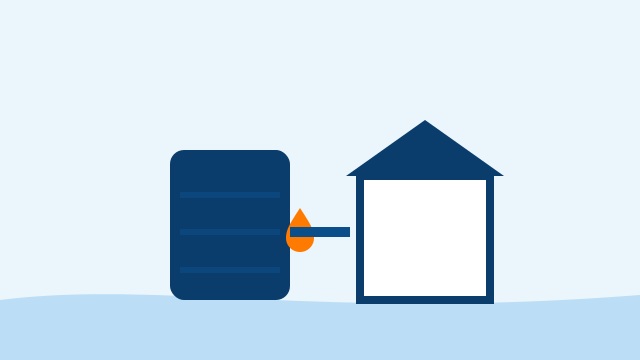
Most Johannesburg homeowners only think about water when it stops. Then the taps run dry, the toilet won’t flush, and the kettle sits empty. Understanding what a backup water system actually does — mechanically, step by step — makes it much easier to choose the right one and to know whether an installer’s quote is solving the right problem.
Why municipal supply isn’t as reliable as it used to be
Johannesburg Water’s own figures show non-revenue water running at 44.8% in the 2024/25 audited period. That’s water leaving the reservoir system and never reaching a paying customer — lost to leaks, burst mains and ageing infrastructure. The city’s reservoir system holds roughly 27 hours of citywide storage buffer, which sounds adequate until a major main bursts at the wrong time or a pump station loses power. Outages that would once have been measured in hours can stretch into days in affected areas.
The result: municipal supply in parts of Johannesburg has become intermittent rather than continuous. A backup water system is the household-level answer to an infrastructure-level problem.
The basic principle: fill when you can, use when you can’t
Every backup water system works on the same logic regardless of its size or price. When municipal pressure is present, water flows into your home in the normal way — but a portion is diverted to fill one or more storage tanks. When municipal supply fails, your taps are switched (automatically or manually) to draw from those tanks instead.
The three physical components involved are:
- Storage — the tank or tanks holding your reserve
- A pump — because tank water is usually gravity-fed at low pressure or needs boosting to reach upper floors
- A switchover mechanism — valves, a float system or an automated controller that determines which source is feeding your house at any given moment
That’s the entire system. Everything else is detail about capacity, quality and convenience.
What actually happens to your plumbing during an outage
Under normal conditions your home sits on direct municipal pressure — typically somewhere between 200 kPa and 600 kPa depending on where you are in the distribution network. Your hot-water geyser, washing machine and showerhead all expect that pressure to be there.
When supply fails, that pressure disappears. If you have no backup system, air enters the pipes and your taps produce nothing or a weak splutter.
With a tank-and-pump backup system, here’s the sequence:
- A pressure sensor or float switch detects that municipal pressure has dropped below a threshold.
- The system isolates the municipal inlet (via a check valve or motorised valve) so your tank doesn’t try to feed backwards into the street main.
- The pump draws from the tank and maintains pressure in your internal pipework — ideally close to what the mains was providing.
- Your taps, showers, toilets and geyser continue to function, drawing on stored water.
- When municipal supply returns and pressure is detected, the system switches back, closes the tank outlet, and begins refilling the tank.
On a manual switchover system, steps 1–3 require you to turn a valve yourself. Automated systems handle it without any action on your part — which matters at 2 a.m. when supply returns.
For a detailed look at how the switch from municipal to tank supply is managed in practice, see our guide on municipal-to-tank switchover.
Sizing: how much water do you actually need to store?
South Africans use roughly 237 litres of water per person per day on average, which is above the global average of around 173 litres. In practice, consumption during an outage drops sharply because people become conscious of what’s in the tank — cooking, drinking, basic sanitation and one shower typically account for 50–80 litres per person per day as a rough guide. Confirm your own household’s realistic usage before sizing a tank.
A family of four wanting two days of autonomy would typically need somewhere between 400 and 650 litres of usable storage as a rough guide — but confirm that estimate with a qualified installer who can account for your specific geyser size, garden irrigation and any other large draws.
Tank sizes range from compact 500-litre units that fit in a garage corner to 5,000-litre or larger underground tanks. Your roof space, available ground area and municipal pressure patterns will all shape the right choice.
What a system costs and what drives that cost
Backup tank-and-pump systems typically cost R20,000–R40,000 for a basic installation, with whole-house configurations running around R55,000. Those figures assume a reasonably straightforward retrofit to an existing house — the cost rises with the number of tanks, the complexity of the pipework, whether you want automated or manual switching, and whether water quality treatment (filtration or UV sterilisation) is included.
The pump alone typically costs R15,000–R35,000 installed, depending on flow rate and whether it’s a pressure-vessel system (which cycles the pump less frequently and is gentler on the motor).
For context, if you’re comparing a backup system to a borehole, complete borehole installations in Johannesburg typically run R40,000–R150,000, with most residential projects falling between R60,000 and R100,000 — though that provides a different kind of supply independence. The full breakdown of how the two approaches compare is covered on the backup water systems pillar page.
If you're ready to see what a system would cost for your specific property, get 3 free quotes from vetted installers — no obligation, no sales calls unless you want them.
Water quality: the part most people overlook
Stored water can become a health issue if the system isn’t designed properly. Tanks exposed to sunlight grow algae. Tanks that aren’t sealed attract insects and debris. Water that sits for extended periods without turnover can develop bacterial growth.
South African drinking water must meet SANS 241 (2024 edition) standards. If your backup tank is part of the potable supply — meaning it feeds your kitchen tap — your system should include a sealed, food-grade tank, a first-flush or filter arrangement, and ideally UV sterilisation or a chemical dosing option for long storage periods.
If the tank is only for non-potable uses (toilets, garden, laundry), the requirements are less stringent, but you should still prevent stagnation.
Always ask any installer specifically how they address water quality — it should come up in their proposal without you needing to prompt it.
Maintenance: what keeps the system working when you need it
A backup system that hasn’t been maintained is not a backup system — it’s a false sense of security. Typical maintenance requirements include:
| Task | Typical frequency |
|---|---|
| Tank inspection and clean | Every 6–12 months |
| Pump pressure check | Every 6 months |
| Check-valve and float-switch test | Every 6 months |
| Filter replacement (if fitted) | As per manufacturer — often 3–6 months |
| UV lamp replacement (if fitted) | Annually |
These are rough guides — your installer should provide a maintenance schedule specific to your equipment. Some installers offer annual service contracts; whether that’s worth paying for depends on your confidence maintaining it yourself.
Comparing installers on maintenance terms as well as price is easier when you have multiple quotes side by side. Request 3 free quotes and ask each installer directly what their service support looks like.
The honest bottom line
A backup water system doesn’t fix Johannesburg’s infrastructure. It insulates your household from the consequences of it failing. The mechanics are straightforward: store water when supply is available, distribute it when supply fails, maintain the system so it actually works on the day you need it. The decisions that matter are tank sizing, pump specification, switchover method and water quality provision — and those decisions are best made with specific quotes from installers who have seen your property, not from generic online guidance alone.
Quick answers
How quickly does a backup system switch over when the municipal supply fails?
An automated system with a pressure sensor can switch over within seconds of detecting a drop in municipal pressure — typically fast enough that you won't notice at the tap. A manual switchover requires you to turn a valve, so the speed depends entirely on how quickly you realise supply has failed. If outages in your area happen overnight or while you're at work, automated switching is worth the extra cost.
Will a backup tank affect my water pressure?
It depends on the pump. A properly specified pressure-vessel pump system should maintain pressure close to what you're used to from the mains. An undersized pump or a gravity-only setup (no pump) will give you noticeably lower pressure, particularly on upper floors. Always ask an installer what working pressure the pump delivers and whether it suits your geyser and shower fittings.
Is it safe to drink water that has been stored in a backup tank?
It can be, provided the tank is food-grade, sealed against light and insects, has adequate water turnover, and ideally includes filtration or UV treatment. Water that sits in a tank for weeks without treatment can develop bacterial contamination. If the tank feeds any potable point — kitchen tap, drinking water — discuss a treatment stage with your installer and ensure the setup meets SANS 241 requirements.
How long will a backup tank last during an outage?
That depends on tank size and your household's actual consumption during an outage. As a rough guide, a household that reduces usage to essential needs might use 50–80 litres per person per day. A 1,000-litre tank would give a family of four roughly three to five days at that reduced rate. Confirm your own usage patterns and size accordingly — an installer can help you model this.
Do I need council approval to install a backup water system?
For most standard tank-and-pump installations within your property boundary, no building plan approval is required, though connection to the municipal supply must comply with local bylaws and should be done by a registered plumber. Underground tanks and any changes affecting drainage or stormwater may have different requirements. Check with your local authority or ask your installer to confirm what applies in your specific municipality.
Sources & notes
Pricing reflects typical Johannesburg market ranges and is confirmed by installer quotation. References: Johannesburg Water
Ready to compare? Get up to 3 quotes from vetted backup water systems installers in Johannesburg — free, no obligation.
Get 3 free quotes