
How it works
Water Continuity for Restaurants and Cafés
By the WaterQuotes team · Published 2026-08-09 · 5 min read
A restaurant without water is not a restaurant — it is a closed building. You cannot wash produce, run dishwashers, maintain hygiene standards, or even flush the toilets that health inspectors require. Yet Johannesburg’s municipal network loses nearly half its bulk supply before it reaches consumers — Johannesburg Water’s own 2024/25 audited figures put non-revenue water at 44.8%. For food-service businesses, that system fragility is a direct trading risk.
This article explains what water continuity actually looks like for restaurants and cafés in Joburg, what systems are available, and how to think about sizing and cost without guessing.
Why Restaurants Are More Exposed Than Most Businesses
A retail shop can often trade through a two-hour outage. A restaurant cannot. Water use in a commercial kitchen is constant and sequential — prep, cooking, plating, cleaning — and every stage depends on flow and pressure. Dishwashers require a minimum inlet pressure to cycle properly. Health regulations require hand-washing facilities to be operational at all times during service. A single unplanned interruption during the lunch or dinner rush can mean turning tables away and losing an entire service’s revenue.
Johannesburg’s reservoir system holds roughly 27 hours of citywide storage buffer under normal demand. That sounds adequate until you consider that a burst main, a pump failure at a local reservoir, or a scheduled maintenance window can drain local pressure in your suburb well before that buffer is exhausted at the system level. Suburbs on the edges of the distribution network — common in parts of Joburg — often experience pressure drops first and recover last.
What a Practical Backup System Looks Like
Most food-service operators who have solved this problem use a two-layer approach.
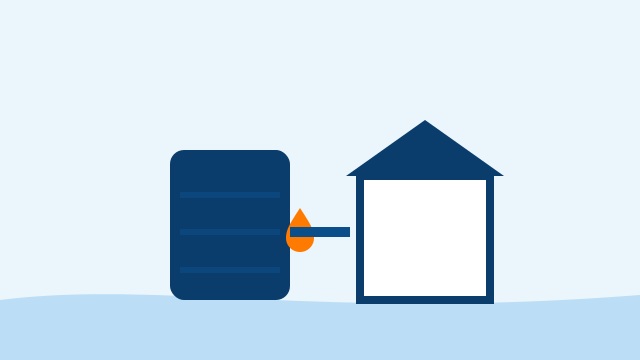
Layer one — storage: A holding tank, usually JoJo or equivalent HDPE, is kept filled by the municipal supply whenever pressure is available. The tank provides a reserve that the kitchen draws from continuously, rather than relying on live municipal pressure. Tank sizing depends on your daily water consumption; a busy café might use a few thousand litres per day, while a full-service restaurant can use considerably more. A water-use audit before installation is worth doing — ask your installer or check your municipal bill for a baseline.
Layer two — pressure: Tanks alone do not deliver the pressure commercial equipment needs. A pressure pump and controller are installed to push water from the tank through your existing plumbing at a consistent pressure. This is what makes the system transparent to your kitchen equipment.
Backup tank-and-pump systems typically cost R20,000–R40,000 for straightforward residential-scale installations, with whole-house or small-commercial examples running around R55,000. A restaurant installation will vary depending on tank capacity, pump specification, plumbing complexity, and whether the system needs to integrate with a fire suppression setup — get site-specific quotes rather than budgeting from a single figure.
When a Borehole Makes Sense for Food Service
For longer or more frequent outages, or where the municipal supply is chronically unreliable in your area, a borehole adds a genuine second source rather than just a bigger buffer of the same source.
The important caveat for food-service use is water quality. Borehole water is not automatically potable. Any borehole supplying water that contacts food, beverages, or food-contact surfaces must be tested and treated to meet SANS 241 (2024 edition), the South African drinking-water quality standard. That typically means filtration and disinfection systems in addition to the borehole itself. Your health inspector will want documentation.
Typical complete borehole systems in Johannesburg run R40,000–R150,000, with most falling between R60,000 and R100,000. Pump installation alone typically costs R15,000–R35,000 installed. Treatment and filtration add cost that varies with what the raw water analysis shows — there is no shortcut to the analysis step.
For a broader look at how these systems work across different commercial premises, the commercial water solutions section of this site covers the full range of options and considerations.
If you want to know what a properly sized backup system would actually cost for your restaurant or café, the quickest route is a site assessment. Compare 3 free quotes — vetted installers, no obligation.
Sizing: The Questions to Answer Before You Buy Anything
Installing the wrong size system is almost as bad as having none. Too small and you run dry during a long outage; too large and you have spent money on capacity that never turns over, which creates its own water-quality risks in the tank.
Before speaking to installers, pull together the following:
| Question | Why it matters |
|---|---|
| What is your average daily water consumption in litres? | Sets minimum tank size |
| What is the longest outage you have experienced in the past 12 months? | Determines storage duration needed |
| What inlet pressure do your dishwashers and equipment require? | Determines pump specification |
| Is your roof or yard suitable for tank placement? | Affects installation complexity and cost |
| Does your premises have existing plumbing to retrofit, or is this a new fit-out? | Major cost variable |
The answers to these questions let an installer give you a meaningful quote rather than a generic package.
Regulatory and Health Compliance
Food-service premises fall under the National Health Act and local municipality health by-laws, which require potable water at food-preparation and hand-washing points. If you are drawing from a storage tank, the tank must be kept clean and covered. If you are using borehole water for any food-contact purpose, treatment to SANS 241 standard is not optional.
The City of Johannesburg’s environmental health officers do inspect commercial kitchens, and water quality and availability are part of those inspections. A backup system that has not been maintained — algae in tanks, failed UV lamps, expired filter cartridges — can create a compliance problem rather than solve one. Build a maintenance schedule into your system plan from the start.
For more detail on how backup systems work in different commercial contexts, the post on commercial water backup basics covers the fundamentals that apply across business types.
Restaurants have specific pressure and quality requirements that a generic tank-and-pump quote may not address — comparing multiple installer proposals helps you spot gaps before they become problems. Get installer quotes tailored to your premises — no obligation, no pressure.
What to Ask Installers
When you are getting quotes, the following questions separate installers who understand food-service requirements from those who are adapting a residential pitch:
- Can the system maintain pressure during peak dishwasher load and simultaneous hand-basin use?
- What is the tank turnover time at our estimated daily consumption, and is that acceptable from a water-age perspective?
- If we want to add a borehole later, can the current design accommodate that without a full rework?
- What maintenance does the system require and at what intervals?
- Do you provide a commissioning certificate we can show to a health inspector?
An installer who cannot answer these questions clearly is not the right choice for a commercial kitchen application.
Quick answers
How much water does a typical Johannesburg restaurant use per day?
This varies widely depending on covers served, menu type, and equipment. There is no single reliable figure that applies across restaurant types. The most accurate starting point is your own municipal bill — look for average monthly consumption and divide by 30. A water-use audit during a normal trading week gives you the most useful number for sizing a backup system.
Can a restaurant use borehole water for cooking and dishwashing?
Yes, but only after the water has been tested and treated to meet SANS 241 (2024 edition), the South African drinking-water quality standard. Untreated borehole water should not be used in food preparation or on food-contact surfaces. Treatment typically involves filtration and disinfection, and you should keep records for compliance purposes.
What size water storage tank does a restaurant need?
Tank size should be based on your actual daily consumption and the duration of outages you want to cover. A tank that holds one to two days of typical consumption is a common starting point, but the right answer depends on your specific operation. Ask your installer to calculate this from your consumption data rather than accepting a generic recommendation.
How long does it take to install a backup water system in a commercial kitchen?
For a tank-and-pump system with no major plumbing rerouting, installation is typically completed in one to two days. More complex installations — multiple tanks, borehole integration, or significant pipework — can take longer. Schedule installation during a period when a half-day or full-day closure is manageable, and confirm the timeline with your installer before booking.
Will a backup water system affect our health inspection compliance?
A properly installed and maintained system should support compliance, not threaten it. Environmental health officers look at water quality, tank hygiene, and whether potable water is available at required points. Keep your tanks clean, maintain treatment systems according to manufacturer schedules, and hold documentation of any borehole water test results. An installer who provides a commissioning certificate makes this easier.
Sources & notes
Pricing reflects typical Johannesburg market ranges and is confirmed by installer quotation. References: Johannesburg Water
Ready to compare? Get up to 3 quotes from vetted commercial water solutions installers in Johannesburg — free, no obligation.
Get 3 free quotes